
Down rounds, Recaps, Oh my!
This week we are bringing you insights into navigating down rounds, the top mistakes founders make when fundraising, and advice from a founder’s perspective.

Greetings! I’m loving all of the Halloween decorations this year! 🎃👻
😱 Down rounds, Recaps, Oh my!
On a recent episode of Consumer VC, host Mike Gileb interviews Steven Finn, Partner at Siddhi Capital, about the challenges VC-backed founders face when things don’t go as planned, especially after raising large sums of money. Steven shares his perspective on the right time for founders to pursue venture capital and the risks of overcapitalization. He explains how overfunded companies often need to “rightsize” their cap tables by cleaning up dead equity and removing early investors. He also notes that the excess capital raised in 2021 and early 2022 has made today’s investors far more cautious and attuned to financing risk, or in laymen’s terms, the company’s ability to raise additional capital down the line.
“Venture capital should be raised to pour fuel on the fire, not find the fire.” — Steven Finn, Partner, Siddhi Capital
STV Take: Even though this podcast focuses on consumer companies, it offers important lessons for any founder on when and how much to raise. We often talk about the dangers of raising too much too early and becoming just an “option” for larger funds, but Steven’s examples make these risks concrete. Sure, it feels great to close a big round with a name-brand investor, but doing so can set the bar for an exit at unrealistically high levels, making it much harder to achieve long-term success.
🔥 The 7 Deadly Sins of Raising Venture Capital
Startup Grind’s article on the seven mistakes first-time founders make when trying to raise venture capital is a great primer for first-time founders embarking on their VC fundraising journey. A few of the “deadly sins” fall into the following:
Sending pitches through email without trying to network your way into a warm intro.
Underestimating how long it will take to get a financing deal done, expect 6-9 months.
Thinking that closing a fundraising round is the end of the journey.
“Entrepreneurs talk all the time about ‘dilution’. That is an absolute waste of time, especially now. The only valuation that is worth mentioning is the EXIT valuation and how the successive rounds of financing have been structured to determine who gets what.”
STV Take: This quote is a perfect follow-up to the podcast. Obsessing over valuation in the earliest stages is the wrong focus and can actually do more harm than good. Raising at a high valuation without the fundamentals in place creates downstream funding risk, as future investors may not see a path to an exit that justifies their investment. High valuations can also come with onerous terms—like steep liquidation preferences—that can significantly impact founders at exit.
💭 Fundraising Advice from a Founder
Ankur Nagpal’s article offers candid fundraising advice from a founder’s perspective. He points out that venture capitalists are often chasing very large exits, which may not always align with a founder’s personal goals. Ankur encourages founders to raise the right amount of capital for their business while still pitching the boldest vision of their company to attract investors. He also highlights the importance of planning for the “medium success case,” so that even if things don’t go perfectly, the outcome is still meaningful and life-changing for the team.
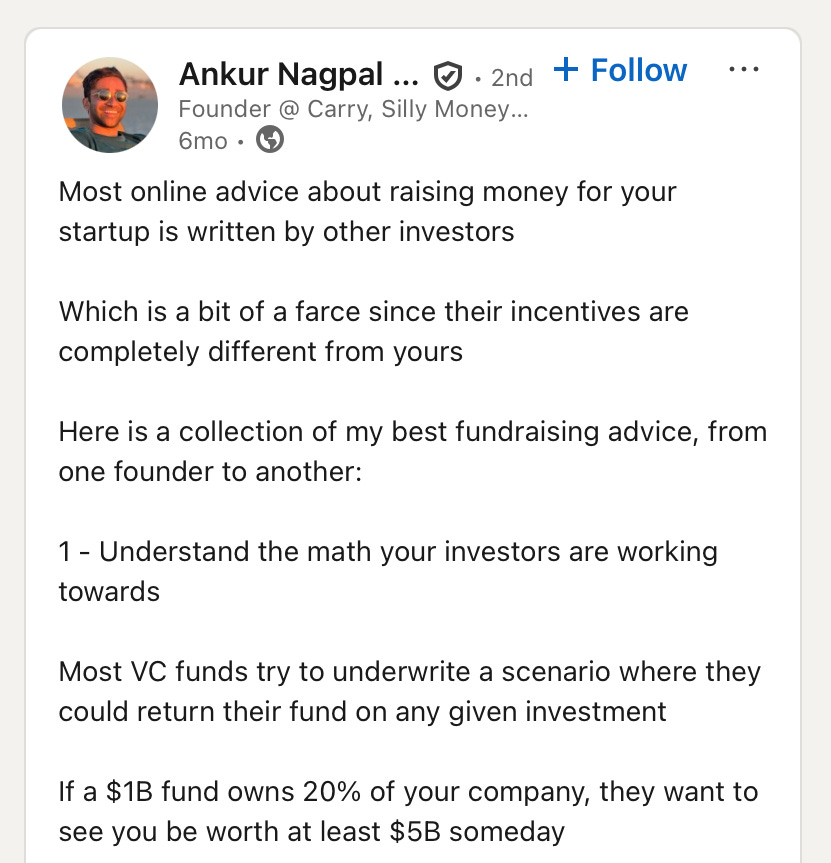
STV Take: Raising venture capital isn’t just about the money—it’s about aligning the raise with the kind of company you actually want to build. Nagpal’s advice reminds founders to balance ambition with pragmatism: aim high to capture investor interest, but make sure the capital and terms you take support a path that’s achievable and meaningful for your team. Thinking through the “medium success case” forces you to be realistic about execution while still keeping the vision compelling, which ultimately sets you up to raise effectively and avoid the downstreaming funding risk talked about above.