
How Start-up Friendly is the Current Fundraising Environment?
This week we are bringing you insights into the supply-demand ratio of venture capital, why speed is critical for Seed companies, and questions all founders should be pondering.

Greetings! Wow, this month is🪽flying🪽 by!
🌡️ Dealmaking Indicator
PitchBook released their latest Dealmaking Indicator, which measures how friendly the fundraising environment is for startups versus investors. It combines data on deal terms, market momentum, and ownership trends to show who currently has the upper hand in negotiations. A higher score means investors hold more leverage, while a lower score signals that conditions are more favorable for founders raising capital. Across all stages, the environment remains investor-friendly; however, companies do have a bit more leverage than they did in 2024.
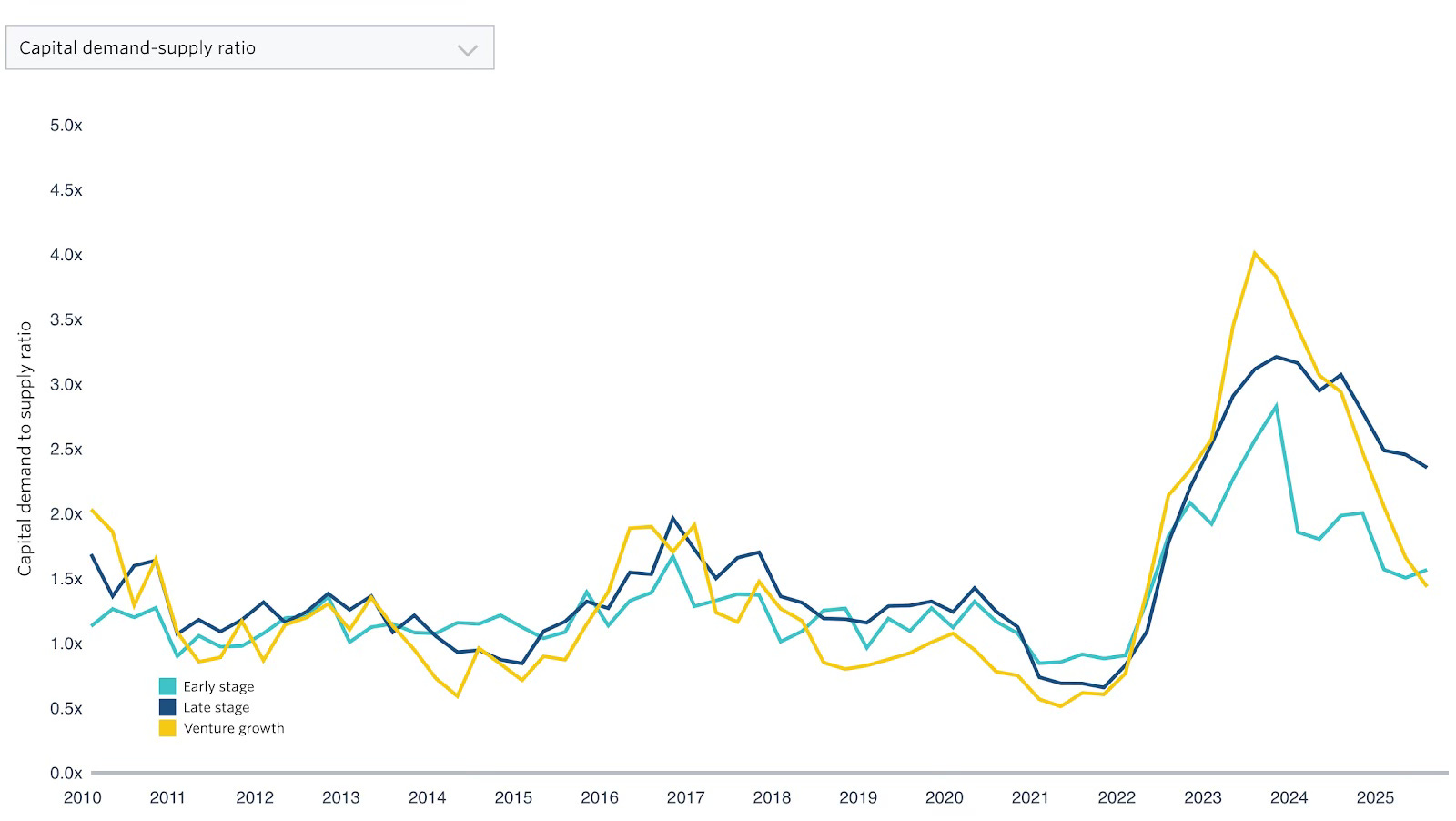
STV Take: I found the above chart fascinating. The capital demand-supply ratio shows just how tough fundraising was across all stages in 2023 and 2024—and why. The demand for capital outpaced supply more than at any other point in recent history. While the market is beginning to rebalance, it’s still a challenging environment. Investors have options, and founders need to focus on telling a clear story on positioning, market opportunity, and why they’re the best ones to go after it.
🏃♀️ Speed as a Lever
Hadley Harris penned a LinkedIn post describing how the biggest predictor of success of raising a Series A is how quickly a founder can iterate. With roughly two years of runway from a Seed round, founders need to find product-market fit within the first year to have enough time to show traction before fundraising again. The best founders treat speed as their advantage—running rapid experiments, learning from customers, and killing ideas quickly—because iteration velocity, not perfection, is what ultimately drives progress from Seed to Series A.
“Seed to A isn’t about polish or perfection, it’s about velocity, learning, and evidence of traction.” — Hadley Harris, Founding General Partner, Eniac Ventures
STV Take: This is a reminder that raising a Seed round is not the end of the journey but the beginning of it. Post-seed round, speed is the greatest asset with founders optimizing for fast learning. The founders that are successful in finding product-market fit and crossing the Seed to Series A chasm are ones that are quick to test ideas, talk to customers, and adapt.
❓Questions Every Founder Should Ask Themselves
A recent YC AI Startup School podcast featured a recorded version of a live talk given by Jordan Fisher, Co-founder & CEO at Standard AI, on the questions founders today should be asking themselves if/when artificial general intelligence (AGI) comes to be, which Jordan believes is two to three years away. He believes AGI will have meaningful implications for anyone building today. While he outlines a lot of great questions, some of the most existential ones he identifies are the following: 1) What is defensible? 2) How do you build consumer/user trust? 3) How does customer buying behavior and expectations change?
“So you need to have a better answer to this question of, what’s your moat? How are you going to stay ahead? In two years or three years, if I can just prompt, Claude 7 or GPT 7 to just replicate your startup, what’s your advantage going to be, right? …Even before AGI, I like to work on hard problems. That’s the moat for me. Everyone has a different type of moat.” — Jordan Fisher, Co-founder & CEO, Standard AI
STV Take: Whether or not you believe AGI is coming in three years, the questions Jason brings up are worth thinking through as a lot of investors are asking themselves the same. Specifically, investors are thinking a lot about defensibility and the types of companies that are best positioned to build moats over time. If you’re fundraising, it’s imperative this be a very clear part of the story.