
More (!) Reports 📚
This week we have another report on the state of VC, a pitch analysis, and predictions for 2026.

Greetings! We hope you’re staying warm. This weather is nuts! 🥶
Pitchbook-NVCA Venture Monitor: Q4 2025
Pitchbook and NVCA released the Q4 2025 Venture Monitor. It outlines a polarized market where a robust, AI-fueled recovery in dealmaking contrasts sharply with a decade-low in new fund commitments. While capital deployment has surged to near-record levels, limited partners remain cautious, creating a challenging landscape for new funds. Key stats below.
AI Dominance: Artificial Intelligence and Machine Learning captured 65.4% of total deal value and 39.4% of deal count in 2025.
Fundraising Lows: Fundraising activity hit its lowest point in over a decade, with only 537 funds closing and total capital raised dropping to $66.1 billion.
Exit Market Value: Despite a low volume of public listings, the exit market generated $297.6 billion in value, the fourth-highest year on record.
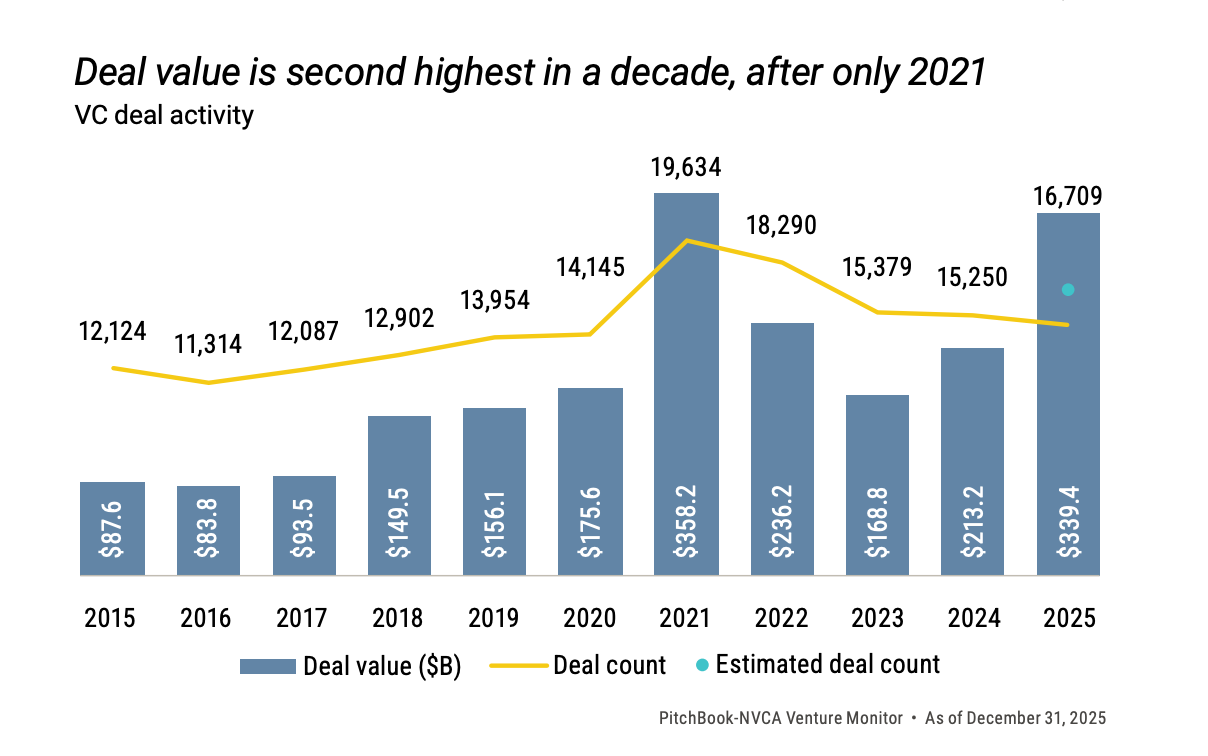
STV Take: The $339.4B headline can look like proof that venture has fully recovered, but the distribution tells a different story. Nearly half of that capital went to a small group of AI infrastructure companies raising $100M+ rounds. Those rounds are the exception, not the norm, which makes it more important than ever for founders to clearly articulate who the customer is, what problem is being solved, and why now is the moment their business works in a way it couldn’t before.
Pitch Teardown
Haley Bryant, Partner at Hustle Fund, does a live pitch review with Ali Summer, CEO & Founder of Sumer Space. The video starts with Ali providing his background and then the pitch for his business. Haley jumps in with questions and then provides the following suggestions to make the deck stronger:
Be specific about the problem being solved.
Reduce jargon. Most investors are generalists and need context, especially if what you’re building is highly technical.
Answer why now is the time to solve this problem.
“Investors only spend 30 to 60 seconds on a deck, often deciding whether to take a call [in that time].” – Haley Bryant
STV Take: We see hundreds of decks that argue “this is a massive problem,” but fail to answer the critical follow-up: “Why hasn’t it been solved yet?” A big market without a specific catalyst is often a trap—a problem everyone sees but no one can fix profitably. Founders often treat the “Why Now” slide as a throwaway, but it’s actually the single most important validation of your strategy. We know the market is big; what we don’t know is why this is the moment it unlocks. Don’t tell us about general trends (e.g., “mobile adoption”). Tell us about the structural break in the market that renders the old way of doing things obsolete and makes your approach the only logical path forward.
2026 VC Predictions
Investors surveyed by Business Insider provided their perspective on 2026’s defining trends. The general consensus was that customers of AI companies will shift from “AI experimentation” to demonstrable “ROI reality”. Other predictions included the following:
Small groups will leverage AI to achieve disproportionately large revenue.
AI tools will evolve from passive software to autonomous “employees” with their own budgets and spending limits.
While some anticipate a broader IPO window, VCs also caution that a correction is imminent for overpriced AI startups that fail to show clear, tangible returns for enterprise clients.
“In 2026, the gap between AI products with tangible, well-defined ROI and those that are perceived as nice-to-have will widen and define outcomes for companies in a way that’s been lost during the mania of the last few years.” – Rob Biederman, Managing Partner, Asymmetric Capital Partners
STV Take: It isn’t the start of a new year without some reflection on what the next 12 months holds! The shift towards ROI shouldn’t be surprising. The hype is fading, but buyers are still willing to spend on solutions that clearly deliver measurable value. After a couple of years of experimentation driven by fears of being left behind, the AI conversation is moving from pilots to proof. Companies have already tested plenty of tools. Now, they’re asking which ones are worth committing real budget to.