
Questions to Ask Before a Fundraise
This week we are bringing you insights into questions founders should ask themselves before fundraising, a fundraising to-do list, and the implications of the cap table on culture.

Greetings! We are past the Spring Equinox and enjoying the extra sunlight! ☀️
❓ Starting with the Right Question
Jainaba Njie shared a LinkedIn post featuring an Eric Partaker graphic that breaks down different types of capital. Her argument is one we’ve returned to often: not every business should raise venture capital. Because VC gets so much of the attention, founders often start by asking who will fund them instead of what they actually need to fund. That distinction matters, because the answer shapes the type of capital they pursue.
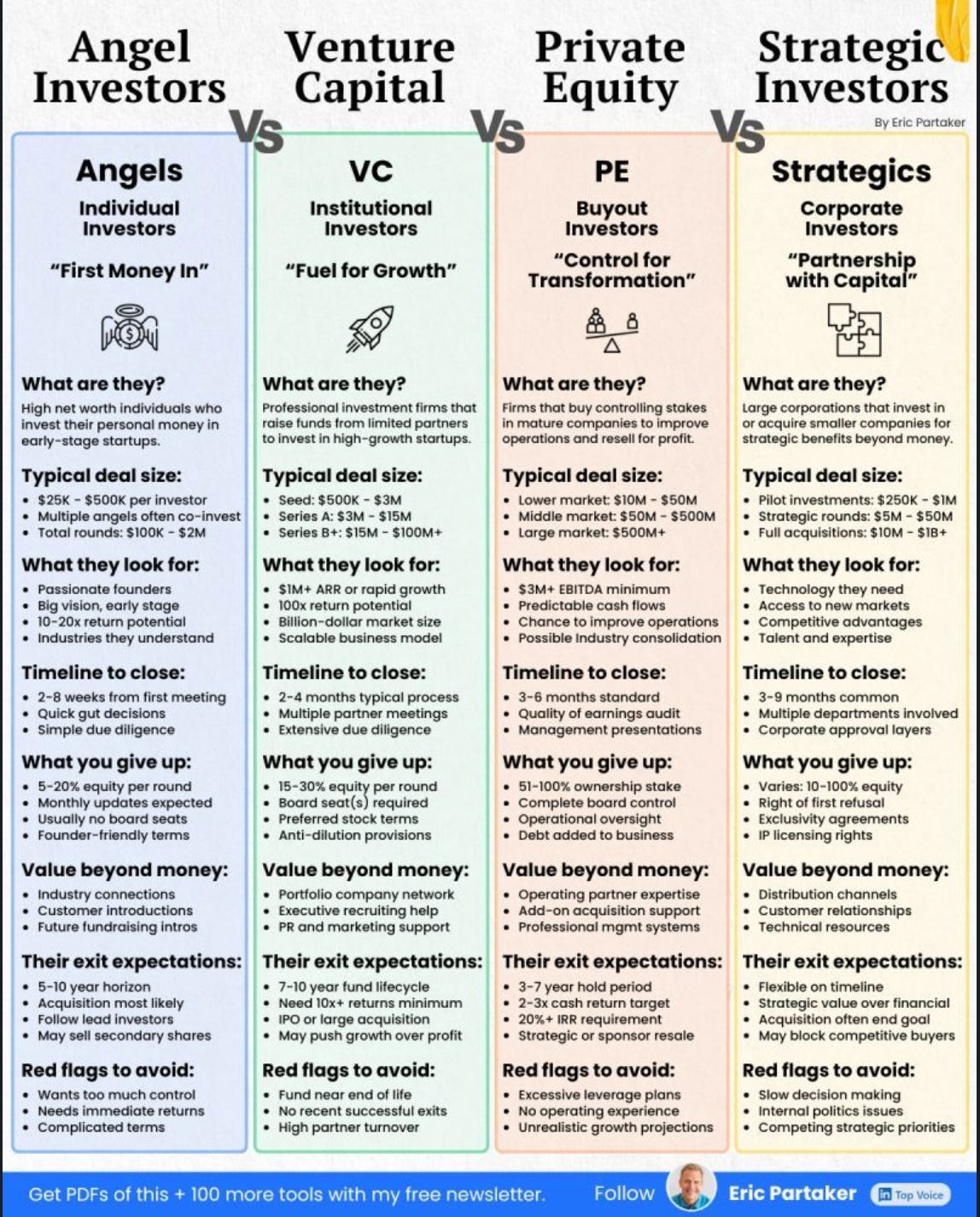
STV Take: This post pushes founders to get more specific about the purpose of the capital they are raising. Venture capital can be a great fit when a business needs fuel for rapid growth and there is early evidence of where that capital can be put to work, but it is often a poor match for companies that primarily need inventory financing, equipment, working capital, or simply more time to compound steadily. Founders can save themselves a lot of wasted meetings by first getting clear on why they are raising money and what kind of business they want to build.
✂️ Measure Twice, Cut Once
In “Measure Twice, Cut Once”, Mark Suster argues that fundraising should be run like a process, which will not be a new idea to long-time readers of this newsletter. He encourages founders to identify the right investors before they begin pitching, qualify them based on fund and stage fit, and use trusted introductions wherever possible. He also discusses how founders should think about targeting individual partners based on career stage and firm tenure.
“So while it might seem like it’s unfair, the golden rule in sales is that when you’re the seller you own follow up. Always. So best to be humble. Not get mad. Understand the other person’s shoes a bit. And find ways to drive the engagement yourself.”
— Mark Suster
STV Take: The strongest point in this piece is the reminder that founders need to qualify investors just as much as investors qualify companies. Not every firm that takes a meeting is truly a fit on stage, sector, check size, ownership expectations, or appetite to lead. When founders skip that work, the process can look busy without actually moving closer to a term sheet. A tighter, better-qualified target list usually does more for fundraising momentum than simply taking more meetings.
👨💻 Cap Tables, Compensation, and Culture
TechCrunch’s Build Mode podcast features General Catalyst’s Yuri Sagalov on the early decisions that shape a startup long before scale, like who is on the cap table, how equity is split, and how founders frame compensation with early hires. Sagalov’s point is that investors are not interchangeable, and that the wrong kind of involvement can be more damaging than unhelpful. He also offers practical guidance on seed dilution, co-founder equity splits, and the importance of being candid with early employees about startup risk. Ultimately, the episode is about treating ownership and incentives as foundational parts of team design, not just legal or financing details.
“Usually, I like to see as a rule of thumb, no more than 20 to 25% dilution by the Seed round.”
— Yuri Sagalov
STV Take: This episode rightfully identifies that the earliest structural decisions in a startup reverberate for a long time. Founders understandably focus on getting the round done, but who ends up on the cap table and how ownership is allocated can shape culture, incentives, and decision-making for years. As we have discussed before, these choices also carry downstream fundraising implications; e.g., giving up too much equity too early (note: the above quote is a good benchmark). A messy cap table can create concerns about founder incentive alignment and room for future ownership, while a difficult investor can introduce governance friction that makes later rounds harder to complete.
Great content for early stage founders. Wish more of this stuff existed when I was getting started.