
Seed: Redefined ⚡
A new framework for Seed, a worksheet for cash runway analysis, and a resource covering the various components of starting a company.

Greetings! If you’re in the U.S., we hope you had an amazing Memorial Day and are ready to make the most of this short week!
🚧 Seed is broken. Here’s how to fix it.
Mattias Ljjungman published an article that describes how the term “Seed stage” is now a misnomer for Pre-Series A rounds. In it, he highlights the evolution of the Seed stage over the last ten years and provides a framework, including typical attributes, for how to think about the various stages and amounts of Seed financing in the current market.
“I wanted a simple, useful heuristic, so I propose categorizing Seed into two distinct groups: Seed Inception, which Ed Sim describes well as initial ticket going in, and Seed Expansion, which describes rounds where founders have already achieved some milestones and metrics.”
STV Take: This post hits at what we’ve been saying for a while now: Seed is no longer a stage but a phase. While Mattias expounds on two rounds of Seed financing, we are seeing closer to three for all but the fastest growing companies. Arguably, some of our observations could be a result of the current cohort of Seed II companies getting caught in market changes and the unpredictable increase in revenue needed to raise a Series A; however, for founders thinking through fundraising, especially if they’re raising pre-product/pre-launch, we’d encourage you to plan for three financing rounds before the Series A.
The piece that is really worth paying attention to in the framework is the premium that investors are placing on “known quantities”; i.e., repeat founders with a proven track record. This means unlocking large pools of Seed capital for first-time founders is extremely challenging and requires more validation of the product and market.
💯 Elevate Your Startup’s Finances & Accounting
Embark on a transformative financial journey with AVL Growth Partners, the premier fractional finance and accounting services firm supporting organizations in pivoting from growth to scale. Founded in 2009, AVL is the strategic ally that understands the multifaceted challenges founders & CEOs face during the growth journey. AVL's seasoned CFOs, backed by a team of expert controllers and accountants, offer comprehensive support crucial for success. Navigate the complexities of growth with AVL Growth Partners – ensuring mindful and scalable success with a team of financial experts at your side. Visit AVLgrowth.com today and elevate your financial game for sustained growth. (Sponsored)
STV Take: Outsourcing your finance function is a no-brainer for startups. We’ve known AVL Growth Partners for over a decade and they have a stellar reputation.
🛫 The Runway to a Series A
Henri Pierre-Jacques, Co-founder & Managing Partner at Harlem Capital, shared a LinkedIn post on why running a cash runway analysis is important and how this impacts fundraising. He also linked to a downloadable Excel worksheet to help founders tactically jumpstart this exercise.
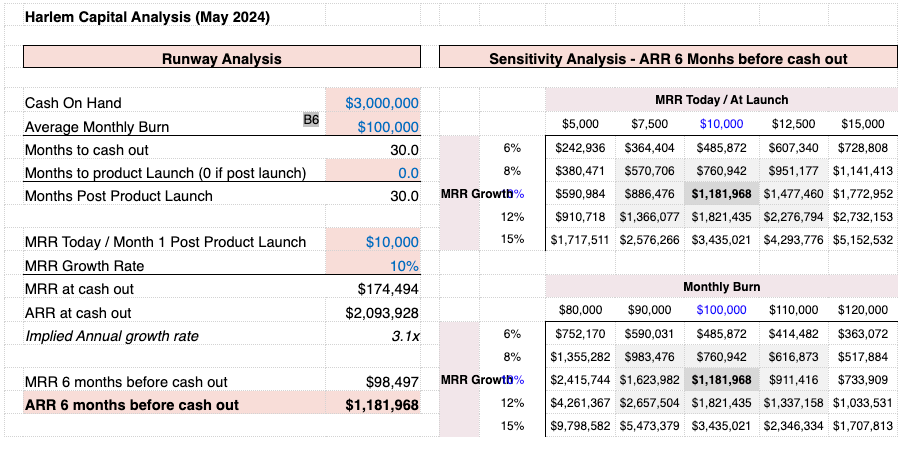
STV Take: This is a really simple way to visualize such a critical concept. As Henri notes, this analysis won’t be true for all startups, but it’s a good starting point. With the general rule of thumb being to start fundraising at least six months in advance of a cash out date, it’s helpful to understand where revenue will be when you start those fundraising conversations. It is also a useful reality check on runway and the monthly growth needed to get to the Series A revenue milestone of $2M before a company runs out of cash.
🗒️ Founder Docs
Wing VC released a set of articles to help founders think through different elements of building a startup. Everything from how to validate your startup idea to hiring is covered in this overview.
“Not every ‘great idea’ is a viable business. Eventually, any product or business has to have a path to making money.”
STV Take: The “Starting a Company” and “Fundraising” sections are a must-read for anyone early in their startup journey. Spending the time to validate your idea before you move forward with building can pay dividends. It helps you avoid “tarpit ideas” and triangulate a specific opportunity. The other critical question that is touched on in the “Fundraising” section is when to start fundraising. Wing outlines two scenarios, extending runway and scaling. I think there is some nuance in fundraising in the “extending runway” scenario and the ability to raise this type of funding pre-product/pre-launch can be challenging for first-time founders. Many investors will want to see some level of traction before investing (the exception here is likely deep tech investors, but again, the bar on the team is still very high). The first article we highlighted covers that nicely.