
Team, team, team
This week we are bringing you two articles on what investors look for when evaluating teams and a post on the 50 reasons why VCs pass. Spoiler alert: there is a section on teams!

Greetings! Welcome to October! 🎃🎃
🐅 Formidable Founders
Paul Graham emphasizes the important trait in founders that investors prize: formidability, which, as Paul describes, is the combination of competence, determination, and the ability to execute. While traction and market opportunity matter, what truly convinces VCs is a founder who projects confidence and demonstrates they can overcome obstacles to build the company. Graham argues that before founders begin fundraising, a founder should assess whether their idea is investable. Going through this exercise builds confidence and determination in a founder that can’t be faked.
“They think they’re trying to convince investors of something very uncertain — that their startup will be huge — and convincing anyone of something like that must obviously entail some wild feat of salesmanship. But in fact when you raise money you’re trying to convince investors of something so much less speculative — whether the company has all the elements of a good bet — that you can approach the problem in a qualitatively different way. You can convince yourself, then convince them.”
STV Take: Paul gets at the painful, but often unspoken truth: early-stage VCs often pass because they don’t believe in the founding team’s capabilities. Founders often think they need to perform some “wild feat of salesmanship” to convince investors their startup will be huge. But in reality, investors are looking for something much less speculative—they want to see that the company has all the elements of a good bet: a strong team with clear market understanding and the ability to execute. Taking the time to deeply understand the business shows that a founder has the competence and resolve to navigate challenges that tends to inspire investor confidence far more than any fancy pitch deck.
🚩Team Warning Signs
Irina Kukuyeva discusses the yellow flags that show up in diligence that are potential indicators that a team may not be equipped to scale a business. These can take many forms—workflows that don’t reflect industry standards (signals lack of domain expertise), co-founders misaligned on priorities, algorithmic outputs that change based on input order (signals a lack of technical understanding), or products that don’t match the pitch. Such gaps erode trust with investors and customers alike, and often point to missing expertise or poor internal communication, both of which make it harder to build a company capable of delivering venture-scale returns.
“If the team is not on the same page now, with only a few collaborators, how will they align and prioritize as the company grows?”
STV Take: It’s easy to obsess over your pitch or product demo, but investors are also looking for signs that a team can actually execute. Small inconsistencies—like differing answers on priorities, workflows that don’t match customer reality, or gaps between what’s promised and what exists—can create doubt about whether the team can scale together. For founders, running a successful fundraising process is predicated on a solid business foundation. The team needs to be aligned, the product needs to deliver, and the workflows need to make sense.
⏭️ 50 Reasons to Pass
Joakim Achren outlined the 50 reasons why VCs pass on a company. He segmented these 50 reasons into five broad categories–strategic & communication, product & execution, financial & fundraising, team, and market & opportunity. Many of the issues discussed are areas we’ve talked about before, including messy cap tables, no clear path to $100M in annual revenue, and no relevant industry experience.
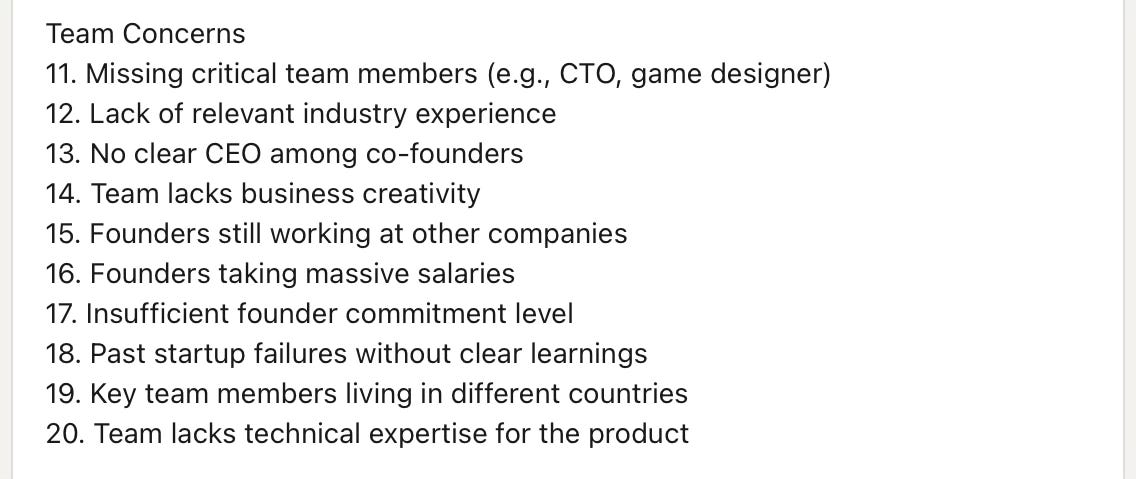
STV Take: The first concern under team—missing critical members—is real, but it’s rare for an investor to cite that alone as a reason to pass. These team gaps usually show up as a lack of industry or technical expertise. As Irina (author of the first article) points out, not understanding the industry increases the risk of building a solution that doesn’t meet the user’s practical needs, while missing technical expertise can slow essential product iterations needed to respond to user feedback. Ultimately, these gaps aren’t just abstract risks—they’re the kinds of misalignments that can prevent a startup from scaling effectively.