
The Term Sheet Sprint 🏃
This week we are bringing you insights into how to properly talk about your revenue, how to make the most of fundraising in Q4, and critical questions every VC asks.

Greetings! Hard to believe Thanksgiving is nearly a week away! As we move into the final sprint before the holidays, we will be pausing this newsletter until January. We hope you have a fantastic holiday season and finish the year strong. 💪
We sincerely appreciate you and the time you take every week to read this! Happy (early) Holidays!
🤯 ARR, CARR Soup
Carlotta Siniscalco posted a plea to founders to stop confusing annualized recurring revenue (ARR), contracted ARR (CARR), pilots and pipe (or pipeline opportunities). In her explanation, she draws a comparison between each of these and dating. ARR is the business relationship equivalent of being married, meaning it’s a done deal and the revenue is live. CARR is more like an engagement where things are locked down and unless one party does something egregious, that revenue will become live. Pilots do not count as recurring revenue, nor do one-off projects. Hopefully this is obvious, but pipeline opportunities with no signed contract do not get counted as ARR.
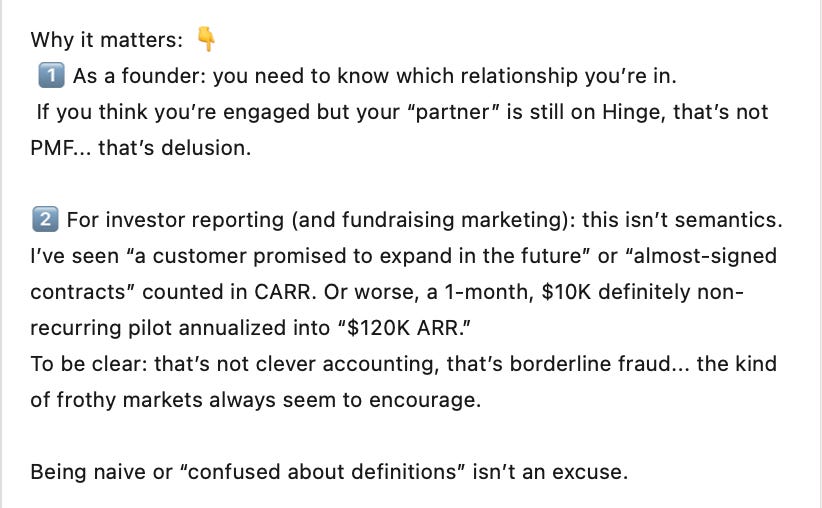
STV Take: This isn’t a new problem, but I agree with Carlotta that it’s cropping up more with the current AI hype. I’ll just be blunt: Confusion around ARR and CARR usually signals one of two things. Either the founder doesn’t fully understand how to measure and report their revenue (which can have material cash flow implications) or they’re being misleading. Neither of these inspires confidence with investors and can have potentially long-term reputational consequences.
🏃 The Term Sheet Sprint
Hypepotamus shared insights from investors and start-up lawyers on what really happens in Q4 and how to make the most of the end of the year. Investors warn that founders pushing for a quick close will face skepticism and will likely be asked tough questions around runway, participation, and urgency. If you do need cash before the end of the year, angels might be an option. Some take advantage of the year-end slowness to get into deals at a discount.
“For founders already in conversations with VCs, Pierce offered tactical advice: keep those relationships warm. VCs ‘love what they do,’ he said. ‘If you can give them something to chew on over the holidays and have that regular conversation, you won’t be restarting in January.’”
STV Take: It wouldn’t be a pre-Thanksgiving VC read without a reminder that landing a term sheet between now and year-end is exceptionally tough. If you’re not already deep in conversations with investors, it’s usually better to wait until after the new year. The scheduling gymnastics make it hard to build real momentum. Instead of kicking off a full process now, share a light update and plan to reconnect with investors in Q1.
❓Four Questions
Christine Lu Hong penned an article on the four questions she believes separate side projects from ideas that can raise venture capital. She gives some fantastic context around each of the questions, along with examples of good and bad answers. The four questions are the following:
Is the founder targeting someone who can actually pay?
Why now? What has changed?
Is your market big enough?
Are there 2-3 competitors already doing this?
“And clarity doesn’t come from thinking harder in your head. It comes from testing faster in the real world.”
STV Take: Too often founders trip over these simple but powerful questions. They may sound obvious, but getting them right forces you to show why your idea matters, how you’ll win, and what sets you apart. Struggle here and investors will quickly write the idea off as a side project before you’ve had a chance to prove yourself. Nail this and you start the conversation from a position of strength.